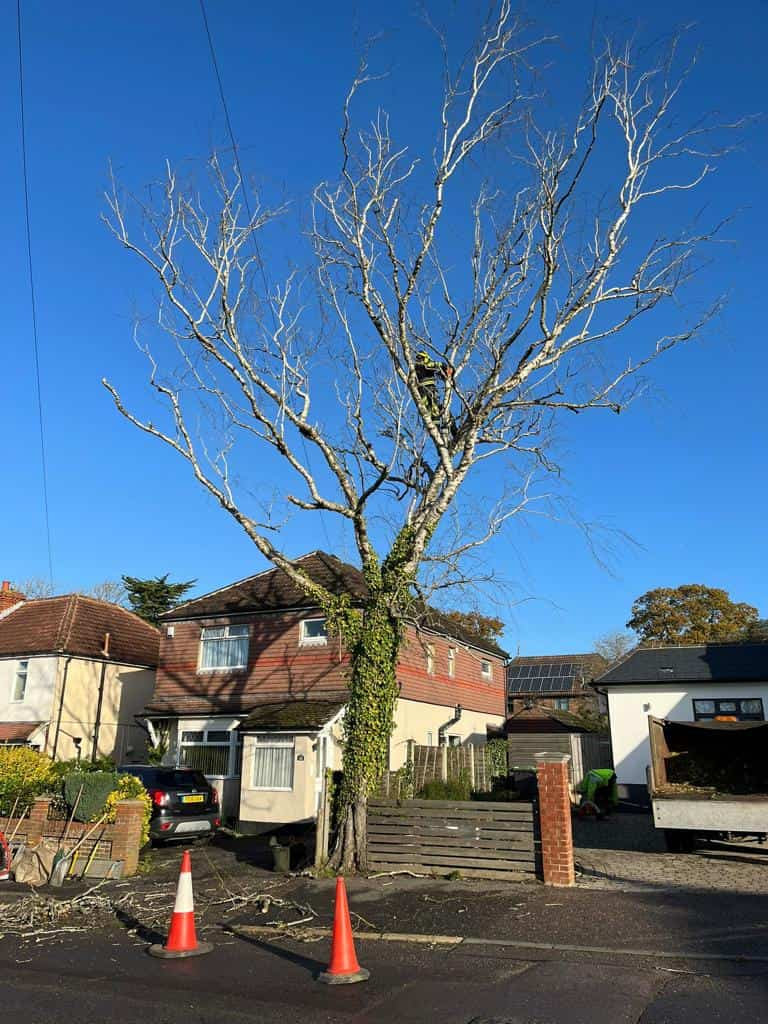
Removing the trunk and crown of a tree does not always mean that the entire plant dies immediately. In some species, the remaining stump and root system retain enough stored energy to produce new shoots. These shoots may emerge from the stump itself, around its base or from roots extending into the surrounding ground.
This regrowth is a natural survival response. Although it may initially appear minor, vigorous shoots can become increasingly difficult to manage if they are repeatedly cut back without addressing the stump.
For property owners in Quedgeley, Gloucestershire, understanding why regrowth occurs can help determine whether monitoring, repeated management or professional stump grinding is the most appropriate next step.
What Causes New Shoots to Grow From a Tree Stump?
The likelihood and extent of regrowth depend on the tree species, the condition of its roots and how much living tissue remains after felling.
The Root System May Still Be Alive
A tree’s roots store carbohydrates and other resources that support growth. After the trunk is removed, a healthy root system may continue supplying the remaining living tissue.
Without a crown, the tree can no longer produce energy through its original leaves. It therefore responds by generating shoots that can develop new foliage and restart photosynthesis.
The larger and healthier the root system was before felling, the more energy it may have available for this response.
Dormant Buds Can Become Active
Many trees contain dormant buds beneath or close to the bark. These buds may remain inactive while the main trunk and crown are healthy.
Felling changes the tree’s normal growth controls. Once the upper structure has been removed, dormant buds around the stump may activate and produce clusters of fast-growing shoots.
This growth is often vigorous because the established root system is supporting a much smaller amount of above-ground material.
Some Species Regrow More Readily Than Others
The ability to regenerate from a stump varies considerably between tree species. Some naturally respond well to coppicing and can produce substantial new growth after being cut down.
Other species are less likely to recover, particularly if the tree was already declining or the root system was damaged. This is why two stumps in the same garden may behave very differently.
Correct tree identification can help indicate whether regrowth is likely to be occasional, vigorous or persistent.
Shoots May Come From the Roots
Not all regrowth emerges directly from the cut surface. Some trees can produce root suckers from living roots located several metres away from the stump.
These shoots may appear in lawns, borders or beside nearby structures. Removing the central stump may reduce the tree’s ability to regenerate, but it does not physically remove every root from the ground.
The source of the shoots should therefore be identified before deciding how to manage them.
The Height of the Remaining Stump Can Matter
A tall stump contains more above-ground woody material and may retain additional areas capable of producing shoots. Cutting closer to ground level can remove some of these potential growth points, but it does not necessarily stop regeneration.
If the stump remains alive and connected to healthy roots, shoots may still emerge around its edges or from below ground. Lower cutting is therefore not always a complete solution.
Repeated Cutting May Not Stop Regrowth Quickly
Removing new shoots prevents them from developing leaves and replenishing the root system’s energy reserves. Over time, persistent cutting may weaken some stumps.
However, vigorous species can continue producing replacement shoots for an extended period. If growth is only cut occasionally, the new foliage may supply more energy to the roots and allow the cycle to continue.
Repeated cutting also leaves the stump in place, along with any obstruction or maintenance problem it creates.
Why Regrowth Can Become Inconvenient
Stump shoots can develop quickly and form a dense cluster of stems. If left unmanaged, they may:
- Obstruct paths or lawn areas
- Compete with nearby planting
- Make mowing and maintenance difficult
- Conceal the stump from view
- Create repeated pruning requirements
- Interfere with plans for landscaping or replanting
The shoots may not have the same structure as the original tree. Several stems growing from around an old cut surface can form weak unions and an uneven shape.
Can Stump Grinding Prevent New Shoots?
Stump grinding removes the main stump by reducing it into small wood fragments below the surrounding ground level. This eliminates much of the living tissue from which stump shoots develop and makes the area easier to reinstate.
The required grinding depth depends on the tree, stump and future use of the site. A stump beneath a planned lawn may require a different approach from one located where new planting or landscaping is intended.
Grinding does not remove the entire root network. Most roots remain underground and decompose gradually, so some species may still produce occasional shoots from surviving roots. The likelihood of this should be discussed during the assessment.
Why the Stump Should Be Inspected Before Work
The size of the stump alone does not determine how straightforward grinding will be. Access, ground level, nearby walls, paving, utilities and other obstructions can all influence the work.
A professional assessment should consider:
- The likely tree species
- Stump diameter and height
- The position of visible roots
- The location of nearby structures
- Access for suitable equipment
- The intended use of the ground afterwards
- Whether shoots are arising from the stump or roots
This information helps determine an appropriate and controlled method of removing or managing the regrowth.
The Value of Professional Stump Management
Persistent shoots indicate that living material remains capable of growth. Simply cutting them back may maintain the appearance of the area temporarily without resolving the stump itself.
EM Tree Surgery Quedgeley can assess regrowing stumps in Quedgeley, Gloucestershire, identify where new shoots are originating and determine whether stump grinding is suitable. This provides a practical basis for managing the area according to its future use.
Conclusion
Some tree stumps continue producing shoots because their roots remain alive and contain stored energy. Dormant buds, natural species characteristics and surviving roots can all contribute to repeated regrowth.
Regularly removing shoots may gradually weaken some stumps, but vigorous regeneration can continue for a considerable time. If a stump in Quedgeley, Gloucestershire, is repeatedly producing new growth, contact EM Tree Surgery Quedgeley to arrange a professional assessment and discuss suitable stump management.
Call us on: 01452 941 558
Click here to find out more about EM Tree Surgery Quedgeley
Click here to complete our contact form and see how we can help with your trees needs.